
If you’ve been following AI news, you’ve seen the same headlines over and over:
- “AI is taking tech jobs.”
- “Call centers are shrinking.”
- “Automation is replacing customer support.”
These stories are real — but they’re misleading.
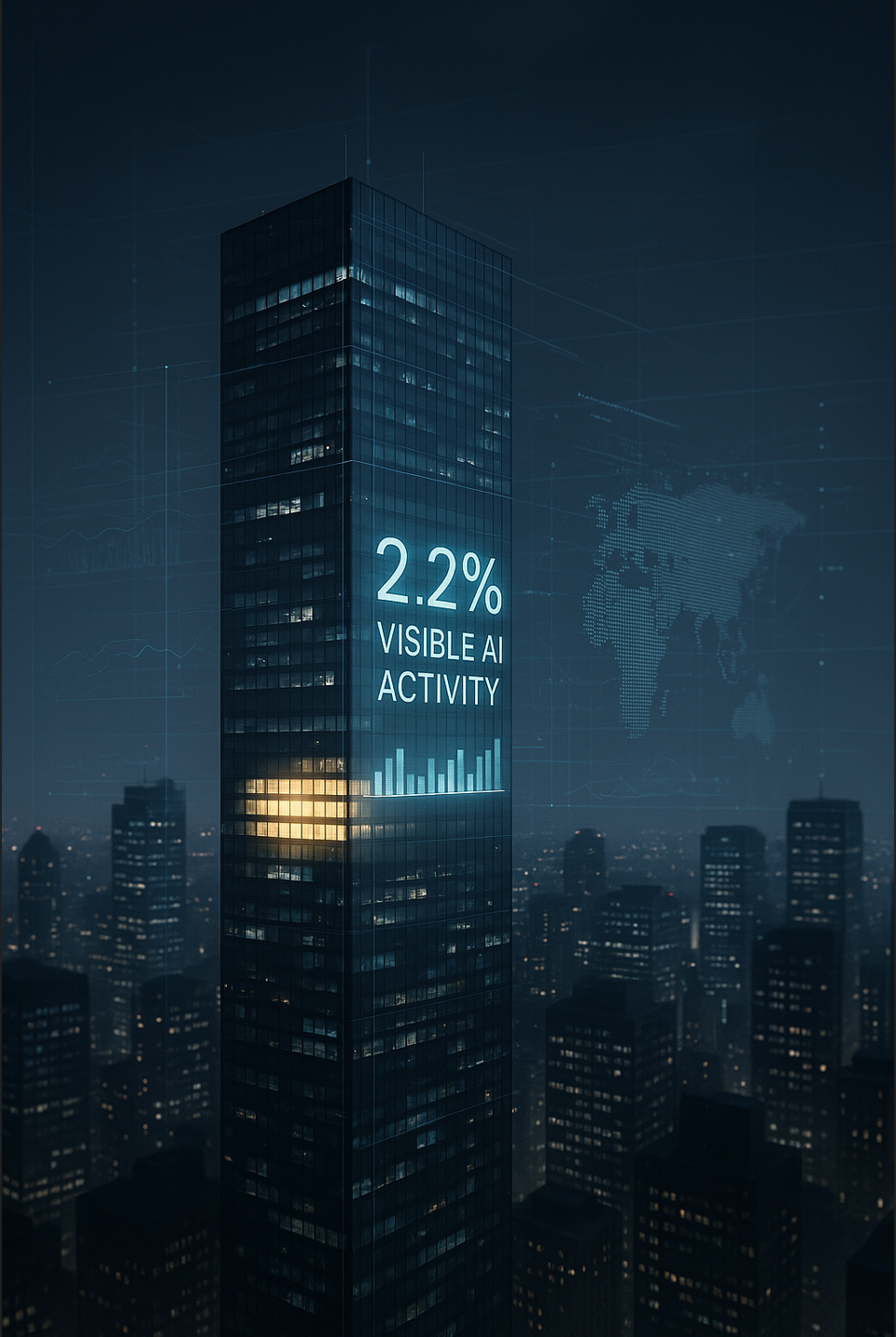
According to MIT’s Iceberg Index research, what we’re seeing today is only the Surface Index: the visible portion of work that AI is affecting right now.
It looks big in the headlines.
In reality?
It represents about 2.2% of the total wage value of skills AI is capable of performing.
Meaning:
98% of the impact is still underwater.
And that’s the entire point of Week 2.
What We See Today = Tiny. What’s Coming = Massive.
The Surface Index captures the narrow slice of AI impact you can point to:
- job postings mentioning AI
- companies adopting AI workflows
- frontline support automation
- tech layoffs or restructuring
- call center optimization
- AI-powered assistants replacing simple tasks
Important? Yes.
But still tiny compared to what’s beneath the surface.
MIT’s data shows the more important story is the Iceberg Index, which captures the underlying tasks and skills — across every occupation — that AI could perform, whether or not any business has implemented AI yet.
Surface-level adoption is a lagging indicator.
Skill-level exposure is the leading indicator.
Businesses focusing only on visible effects are playing yesterday’s game.
Why Tech Headlines Distract Us
Tech is only about 6% of the workforce.
Yet it receives:
- 90% of the media attention
- 95% of the “AI job loss” stories
- nearly all of the visible Surface Index activity
The irony?
The biggest AI exposure isn’t in tech at all.
It’s in:
- administrative roles
- customer support
- finance
- professional services
- legal
- healthcare admin
- back-office operations
These jobs don’t make headlines when they shift — but they represent millions more workers.
The visible 2.2% is overshadowing the invisible 11.7% of exposure beneath the surface.
Surface Activity Is a Lagging Indicator — That’s Why Leaders Get Caught Off Guard
Here’s the trap:
Leaders watch headlines instead of looking at skills.
They react to visible AI changes instead of planning for the hidden ones.
And then they’re surprised when:
- their admin workload suddenly becomes automatable
- customer support begins shifting in-house
- back-office operations get streamlined overnight
- employees need upskilling faster than expected
- competitors adopt AI in areas “nobody was talking about”
The Iceberg research shows that surface adoption always lags behind hidden exposure.
Predicting AI impact by watching news cycles is like predicting an iceberg by staring at the tip.
Why the Surface Index Matters (But Not How You Think)
The Surface Index tells leaders one crucial thing:
We are at the very beginning.
What we see now is not the peak.
It’s the preview.
If 2.2% of visible activity is already reshaping headlines, customer experience, and service expectations…
What does the next 5% look like?
Or 10%?
Or when businesses start integrating AI based on task-level exposure instead of just experimenting?
This is why Week 2 matters:
The Surface Index shows us where AI adoption starts, not where it ends.
What Businesses Should Focus on Instead
Smart businesses don’t wait for visible disruption. They plan for hidden exposure.
Here’s where forward-thinking companies are focusing:
- AI-readiness of internal workflows
Not “Do we use AI?” but “Which tasks can AI take over?” - Task-level automation strategy
Breaking down job roles into skills, then mapping exposure. - Human talent moving up the funnel
Let AI handle routine tasks so humans can focus on complexity, nuance, and customer retention. - Hybrid human + AI models
Particularly in support, scheduling, intake, and admin-heavy operations. - Onshoring customer service
One of the biggest short-term shifts: instead of outsourcing support, businesses use AI receptionists and assistants to bring service back in-house.
The companies who act on hidden exposure before it becomes visible will become the new leaders.
Why the Surface Index Is Your Early Warning System
If you only pay attention to public AI adoption, you’ll adapt too late.
But if you use the Surface Index as a signal — and the Iceberg Index as your roadmap — you can:
- redeploy your team strategically
- upskill ahead of the curve
- automate the right tasks, not random ones
- avoid surprise workforce disruptions
- stay ahead of competitors waiting for the headlines
This is how companies avoid panic and build resilience.
Final Takeaway
Visible AI activity today — the Surface Index — is only the beginning.
It’s the tip of the iceberg.
MIT’s research shows that most of the AI impact is hidden:
- in skills
- in tasks
- in back-office functions
- in white-collar workflows
- in every industry, not just tech
If you prepare based on what’s visible, you’ll be behind.
If you prepare based on what’s hidden, you’ll be ahead.
Source: Benzell, S. G., Chen, W., Crawford, G., Chugg, D., Davis, F., DiNicolantonio, M., Fairbank, A., Feng, X., Gómez, M., Sundaresan, H., & Xue, Z. (2025). The Iceberg Index: Measuring workforce exposure in the AI economy (MIT Working Paper). Massachusetts Institute of Technology. https://arxiv.org/abs/2510.25137

Leave a Reply